
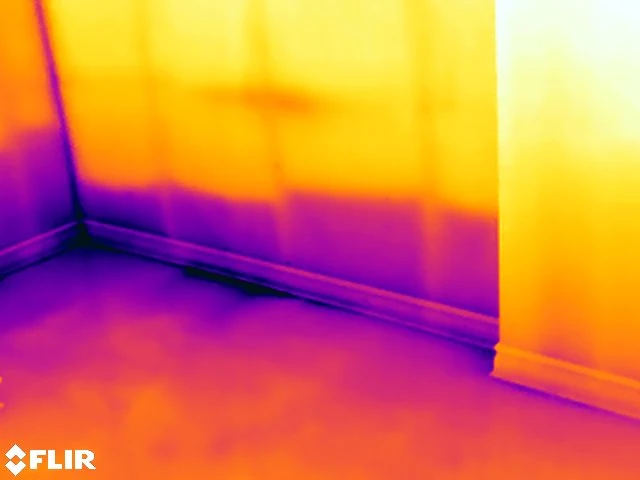
On a thermal image, a patch of colour can look like a clear answer. It is actually the start of an explanation. The camera makes surface-temperature differences visible; understanding what produced them requires context that the colours cannot supply on their own.
Read the pattern before naming the defect
Thermal anomalies suggesting possible insulation gaps have led us to recommend further evaluation. Metal bracing has also been noted as a possible explanation for a pattern that might otherwise be mistaken for missing insulation. In both cases, the pattern is the observation and the proposed cause still needs support.
A thermal camera detects infrared radiation from surfaces. It does not photograph insulation through a wall or directly show hidden moisture. Materials, reflections, environmental conditions and the assembly can affect interpretation. A strong colour contrast is not a measurement of a concealed defect’s size or severity.
Put the room and conditions back in the picture
A corresponding visible-light photograph helps locate the observation and show its surroundings. Keep that view with the thermal image and the written interpretation. Without the location and explanation, an isolated screenshot can be misleading, especially if used to draw conclusions about another property.
Ask whether indoor and outdoor conditions were suitable for the question being investigated. Recent heating, cooling or sunlight may affect the view. Accessible surfaces also matter: furniture, storage and other obstructions can restrict a survey. Comparisons between images need those conditions to be understood, rather than treated as interchangeable snapshots.
Test the explanation
Follow-up should be chosen to answer the actual concern. Further visual access, moisture measurements or assessment by a qualified building-envelope or insulation specialist may be appropriate. These steps need safe access and a defined purpose; recommending an investigation does not mean a wall cavity was opened or a repair completed.
An image alone cannot diagnose mould, structural adequacy, an active leak or a concealed wiring fault. Before approving work, ask what additional evidence would support or challenge the proposed cause. A recommendation about possible missing insulation should remain provisional until that investigation provides a sounder basis.
Thermography can contribute to understanding a building, but it is not a whole-building energy audit and cannot guarantee retrofit savings. An insulation proposal also needs to account for air leakage, moisture, ventilation and the assembly. If an additional energy assessment is recommended, establish what it would measure or clarify beyond the current observation.
For a homeowner, the most useful thermal result is an image pair with a clear explanation of the pattern, the conditions and the next investigative step. Keep those together when discussing repairs. The value lies in directing attention to a question worth answering, with uncertainty stated clearly enough that a possible defect is not mistaken for a confirmed one.