
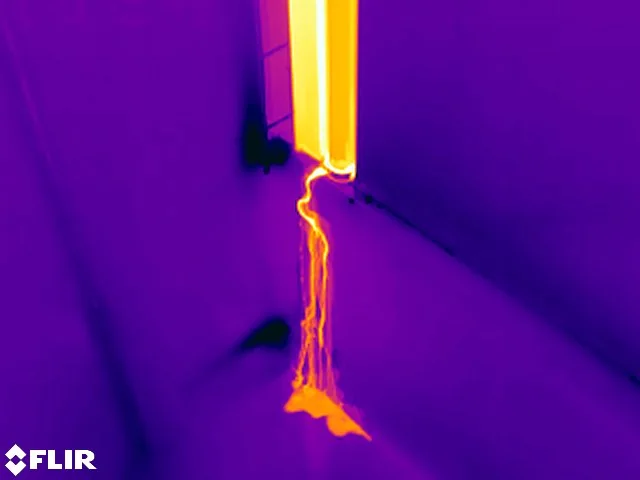
Fresh grout and clean tiles reveal little about what happens when a shower runs. Water may show itself at an enclosure or faucet while leaving its route behind the finishes uncertain. For a buyer, finding the leak is the beginning of the investigation, not the point at which the repair can safely be assumed.
Follow the water, not the finish
Leakage at shower enclosures and dripping or leaking faucets have required follow-up in our inspections, including immediate attention where warranted. A faucet drip may be relatively localized; a shower concern can call for a broader investigation. The visible symptom does not establish a shared cause.
Repeated wetting can affect adjacent finishes and materials. Its extent depends on the amount of water, how regularly leakage occurs and where it travels. Briefly operating a fixture cannot establish the condition behind tiles, beneath a shower base or inside a wall, and it may miss an intermittent problem.
A professional may need to examine connections, seals, drainage, enclosure details or concealed waterproofing. These are possible avenues of investigation, not causes proved by the leak alone. Applying more surface sealant without understanding the water path can leave the underlying issue unresolved. Leakage also does not, by itself, establish mould or structural damage.
What a thermal view contributes
We have used thermal imaging to help investigate shower concerns where access allows. It shows surface-temperature patterns that can direct attention to an area needing further assessment. A pattern alone does not prove wet material or explain where water originated.
Ask which fixture was operated, what was visible and whether confirmatory moisture readings or additional tests were documented. The thermal view should be interpreted with those observations and any documented follow-up. It remains a screening tool, with the same need to account for access restrictions and concealed materials.
Act on the leak and clarify the repair
Arrange prompt professional assessment of active leakage and avoid continued use of a fixture known to leak until appropriate advice is obtained. If water is near electrical equipment, avoid contact and obtain qualified help. These immediate decisions should not wait for certainty about every concealed detail.
Safe shutoff access is another practical concern. We have encountered an inaccessible water shutoff; that is an access issue, not evidence that the valve failed. Identify the appropriate shutoff and arrange access in advance without forcing an unfamiliar or obstructed valve.
For a purchase, ask the appropriate licensed contractor what can be assessed without opening finishes and what requires further access. Clarify the investigation and repair scope before relying on a cosmetic repair or cost allowance. In a condominium, discuss access and responsibility with the appropriate parties rather than assuming the concern belongs entirely to the unit.
Request the available repair description and evidence of follow-up. An inspection observation does not establish that later work was completed or successful. A visual inspection records accessible conditions at a particular time; it is not a flood test or a guarantee against future leakage. Storage, furnishings and restricted access can leave important areas unseen, and photographs cannot establish hidden damage, leak duration or a health diagnosis. Keep those limits with the repair discussion so that a tidy finish is not mistaken for a verified result.