
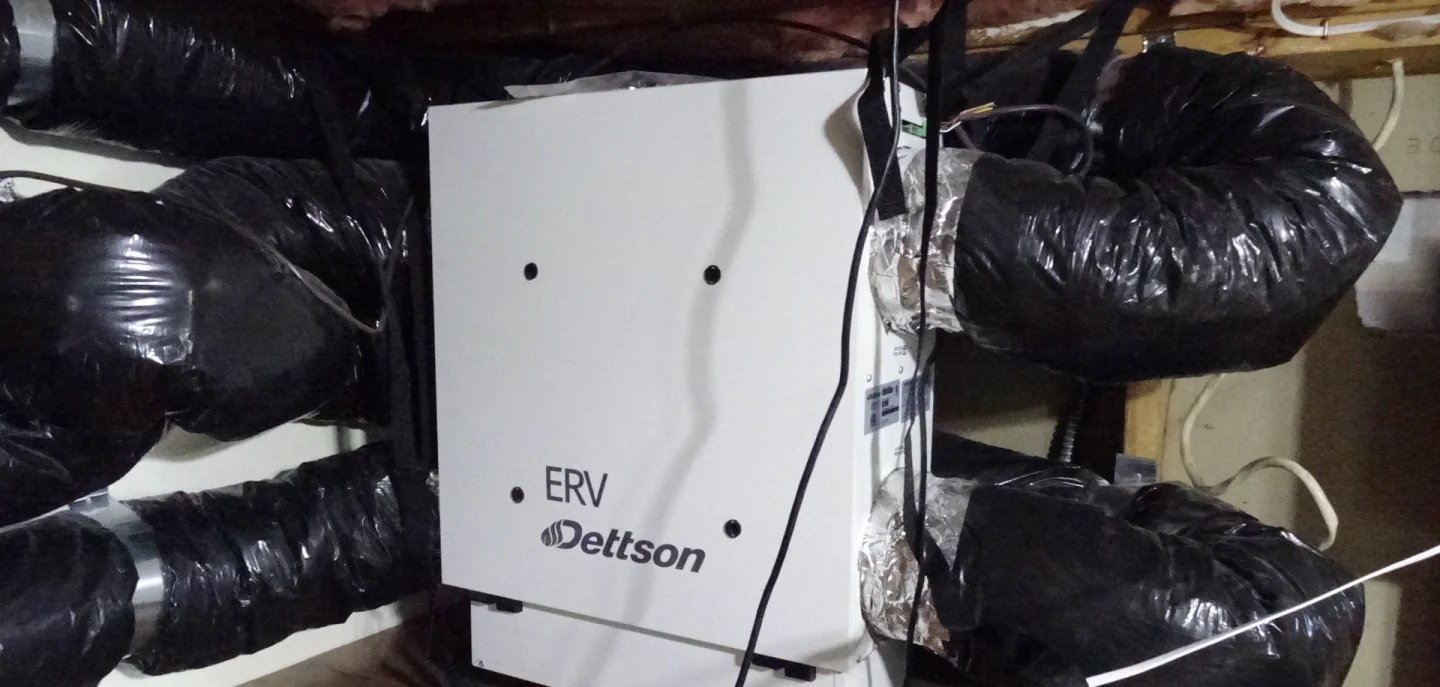
Switching on an air exchanger starts the equipment, but it does not tell you whether its filters, drainage and duct connections are in good condition. Understanding what those parts do makes maintenance less of a guessing exercise, especially when a Montreal home’s service history is unclear.
Air and condensate take different routes
Filters collect material from the air passing through the equipment. Ducts carry air between the unit and connected rooms or outdoor terminals. Where the equipment produces condensate, a separate drain handles that water according to the unit’s design. These parts work together, but a concern in one does not diagnose the others.
Dirty filters, condensate tubing described as blocked or crimped, and leakage at duct or grille connections are findings from our inspection work. A missing condensate-drain trap and uninsulated exhaust ducting in an unconditioned space have also warranted attention. Each needs its own assessment; the observations do not establish a shared cause or measured performance loss.
Restricted drainage can interfere with condensate removal. Dirty filters and duct leakage can affect operation, while moist air meeting a sufficiently cold surface may create condensation. These possible mechanisms help guide investigation. A visible condition check does not quantify airflow, establish system balance or provide a laboratory assessment of indoor air quality. Leakage at a connection also needs examination to determine its nature rather than assuming an air or water diagnosis.
Use the manual for the equipment you have
Filter appearance can suggest a need for attention without revealing the last service date. A crimped tube may need its route or support reviewed; another restriction may require further examination. A ventilation technician should compare the installation with the correct manufacturer’s instructions and identify any additional performance checks needed.
Follow that manual’s safe shutdown and maintenance instructions. Some filters are washable, while others must be replaced. Keep service records and seek help when equipment is inaccessible, leaking or difficult to maintain safely. CMHC’s HRV maintenance guidance includes filters, outdoor openings, the heat-exchange core and condensate drainage.
Equipment-specific advice matters for corrections too. A missing-trap finding is not an instruction to add a trap to every appliance. Duct insulation, sealing, dimensions and terminal clearances need assessment for the actual installation, rather than a generic retrofit prescription.
Room exhaust needs a separate look
Kitchen ventilation that did not discharge outdoors has required attention in our inspections. Recirculation and outdoor exhaust perform different jobs. Recommendations to improve bathroom fan controls address another part of operation: a timer or humidity control may help, but it does not verify the discharge route or adequate airflow.
We have also referred dryer exhaust positioned too close to an outdoor heat-pump coil for specialist review. That proximity concern does not quantify a performance effect or establish a universal clearance. Alterations need to account for the particular equipment and building, including shared systems in condominiums.
Restricted access can leave parts of a system unseen. A running fan or clean filter does not establish system balance, and these observations cannot diagnose mould. When arranging service, distinguish routine maintenance from performance testing: ask what was cleaned or corrected, what was measured and what remains unverified. That record will be useful long after the sound of the fan has reassured you that the switch works.